

- Ankle sprain during sports or everyday life
- Torn ligament in the foot or ligament overstretching
- Repeated sports injuries
- misalignments of the foot
- Ankle fractures
- Overuse or improper footwear
- Mechanical impingement (impingement)
Ankle pain
Symptoms
Your ankle orthopedist for acute and chronic complaints in Innsbruck.
As one of the body’s most heavily used joints, the ankle requires assessment by an ankle orthopedist when symptoms such as pain or instability occur. In orthopedics, the joint is functionally divided into two parts that work closely together to enable walking on uneven ground and the rolling motion of the foot. It connects the foot and lower leg and is subjected to high loads with every step—especially in everyday life, during sports, and with rapid changes of direction.
Symptoms can arise suddenly, for example after twisting the ankle or a fall, or develop gradually due to overuse, malalignment, or wear and tear. Common causes include sports injuries such as a torn ligament in the foot, as well as degenerative changes or recurring irritation.
As an experienced orthopedist in Innsbruck, Dr. Gregor Pittl supports you with precise diagnostics and individually tailored—preferably conservative—treatment concepts.

Dr. Gregor Pittl
Medically reviewed by
Specialist in Orthopaedics, Orthopaedic Surgery and Traumatology
Dr. Gregor Pittl is a specialist in orthopaedics, orthopaedic surgery and traumatology and worked for ten years, most recently as a senior physician, at the University Clinic for Orthopaedics Innsbruck. His focus is on the conservative and surgical treatment of joint wear (arthrosis) as well as regenerative therapy methods such as ACP autologous blood therapy.
Last medically reviewed on 20. July 2026
More about Dr. Gregor Pittl
How do ankle complaints develop?
Cause
The ankle is a complex interaction of bones, ligaments, tendons, and muscles. Even minor disruptions in this system can cause pain or instability. Complaints most commonly arise after sports injuries, for example from twisting the ankle, landings, or sudden changes of direction.
Repeated micro-injuries, muscular imbalances, or previous injuries can also cause long-term problems. If a torn ligament in the foot is not treated adequately, this can lead to chronic instability and recurrent injuries.

Common causes of ankle problems:
Symptoms of ankle complaints
Symptoms
An ankle orthopedist can define conditions more precisely based on your symptoms. The wide range of symptoms extends from acute pain to chronic overuse, insecurity/instability, or recurring irritation. Because the joint is very compact, pain often radiates into the entire foot or the lower leg.
Typical warning signs include:
- Pain when walking, running, or rolling off the foot
- Swelling or bruising after injuries
- Inability to bear weight and a feeling of instability in the ankle
- Pain caused by sports injuries
- Pressure pain or pain on loading (along the tendons)
- Repeated twisting of the ankle
- A feeling of locking
Diagnosis & treatment with ankle orthopedist Dr. Pittl
Treatment
Diagnosis of the ankle follows a systematic process of exclusion to distinguish between fractures, torn ligaments, and cartilage damage. Treatment today is usually functionally oriented, meaning that casts are avoided whenever possible so the joint can be moved in a controlled manner again at an early stage.
Diagnosis is carried out in the following steps:
- Detailed medical history: accident mechanism, onset of symptoms, load
- Clinical examination: assessment of stability and palpation of pressure-pain points
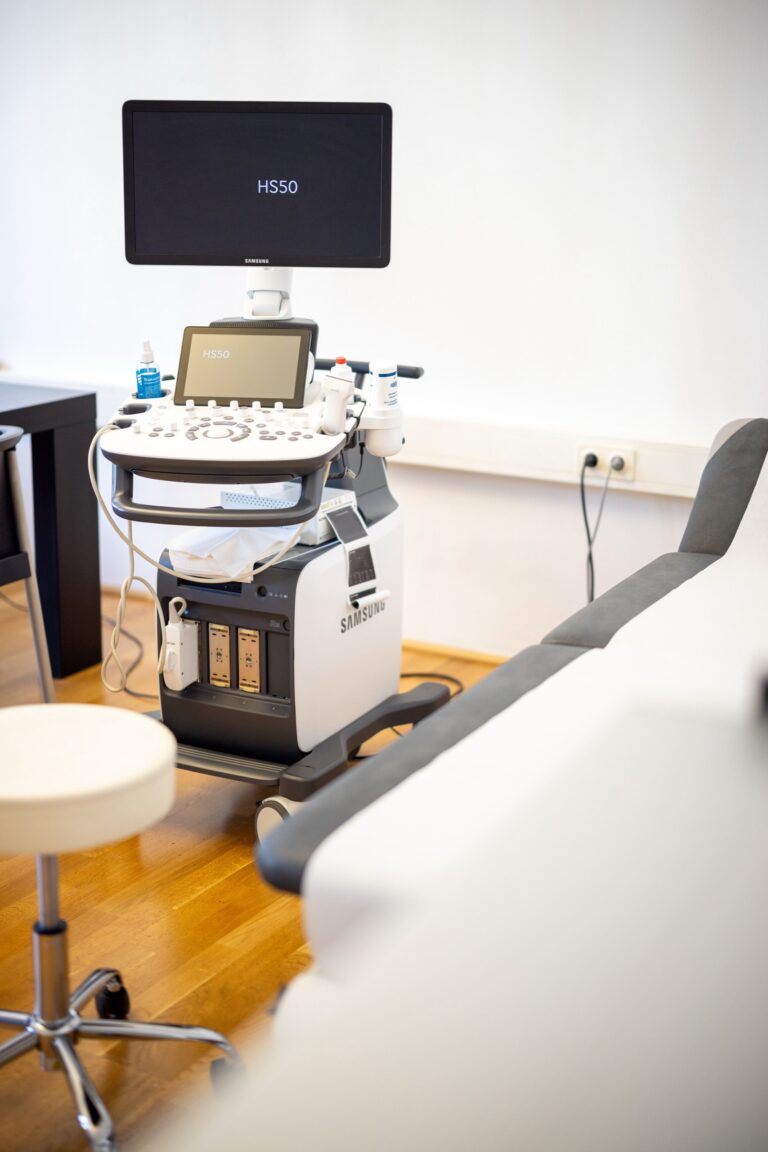
- Imaging such as X-ray, MRI, or ultrasound if ligament or cartilage damage is suspected
Conservative therapy for ankle complaints
Most ankle injuries can be treated conservatively. As an ankle orthopedist, Dr. Pittl initially relies on the following proven measures:
- Physiotherapy to improve stability and coordination
- targeted muscle strengthening and balance training
- Braces or orthoses for instability, to protect against twisting again
- Anti-inflammatory injections for irritation
- Shockwave therapy and magnetic field therapy
- Injection therapy: In cases of osteoarthritis, hyaluronic acid or autologous blood therapies (PRP) can improve joint lubrication
- Adjustment of sporting load
- Orthotics to relieve the ligaments and tendons of the ankle
Your ankle specialist in Innsbruck
Dr. Gregor Pittl
Ankle complaints should not be underestimated, as untreated injuries can have long-term consequences.
Contact us if you would like to have your symptoms assessed by an experienced ankle orthopedist. You are also welcome to schedule an appointment in our private consultation hours.

Frequently Asked Questions
When should I consult an orthopedist for ankle pain?
If pain, swelling, or instability persists or occurs after an accident, an orthopedic evaluation is advisable.
What is a Ligament Tear in the Foot?
A ligament tear in the foot typically results from twisting or spraining, leading to pain, swelling, and instability. In many cases, treatment is conservative.
What is the most important immediate measure after twisting your ankle?
The standard rule in sports medicine and orthopedics is the PECH rule: rest – ice – compression (pressure, e.g., a compression bandage) – elevation. The sooner you start this treatment, the less swelling there will be and the shorter the resulting pain phase.
Can you also develop arthritis in the ankle joint?
Yes, however, compared to the knee or hip, it rarely occurs “just like that.” In over 70% of cases, it is a late consequence of an accident (old fracture or years of instability) that has worn down the cartilage over time.
How long does recovery take after a torn ligament in the foot?
The recovery time depends on the severity. Minor ligament injuries often require a few weeks, while a complete ligament tear can take several months, especially with athletic activity.
What to do if the ankle keeps giving way?
Repeated ankle rolling often indicates chronic instability. An orthopedic evaluation and targeted stabilization training are recommended to prevent subsequent injuries.