


Author & Medical Review: Dr. Gregor Pittl, Specialist in Orthopaedics, Orthopaedic Surgery and Traumatology in Innsbruck · ISMST-certified in Shockwave Therapy Last Medical Review: October 2026 · Reading time approx. 10 minutes
For calcific tendinitis, focused shockwave therapy (ESWT) is the first-choice method among non-surgical treatments according to the current guidelines of the DIGEST professional society – provided the shoulder is not in the highly acute pain phase.¹ For tendon irritations without calcification, it is used as a supplement to exercise therapy. Surgery is rarely necessary.
Treatment is outpatient, in a few short sessions, without incisions and without downtime on the day of treatment. The effect builds up over weeks. Whether shockwave therapy is suitable for you depends on what is actually causing your pain – calcific deposits and tendon irritation feel similar but progress differently. This article explains the differences, shows how diagnosis and treatment proceed in the practice, and answers the most frequently asked questions.
Why is the shoulder so susceptible?
The shoulder is the most mobile joint in the body. This mobility comes at a price: the joint’s stability is primarily provided by muscles and tendons, especially the rotator cuff. Its tendons run through a narrow space under the shoulder roof and are stressed with every movement above head height.
In Tyrol, this often affects people who are physically active or work a lot overhead: climbing, skiing and ski touring with pole use, tennis, swimming, fitness training – but also manual trades involving overhead work. Similarly, long days at a desk with hunched shoulders can strain the tendons over years. With increasing age, blood flow to the tendons also decreases; they regenerate more slowly.
What happens with calcific tendinitis?
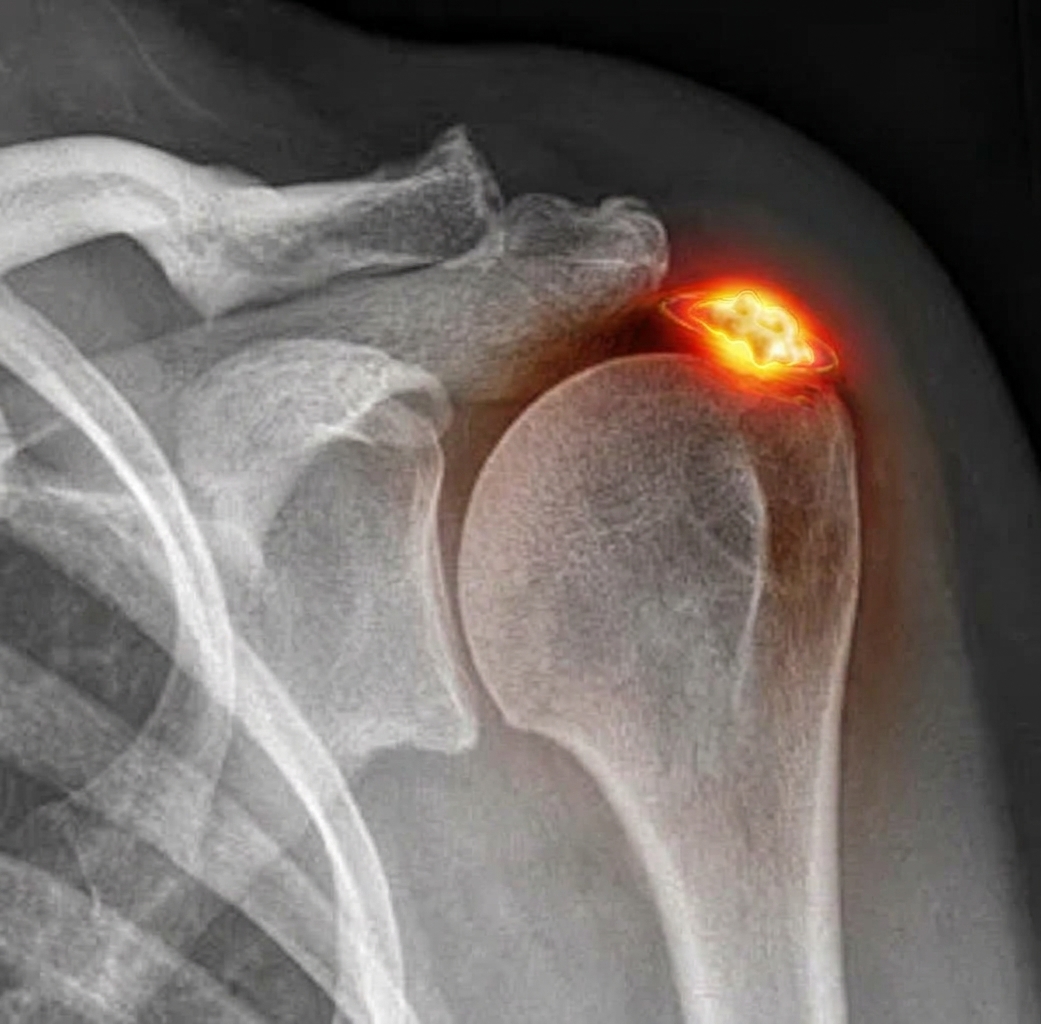
In calcific tendinitis (medically: tendinosis calcarea), calcium deposits form in a rotator cuff tendon. It is one of the common causes of shoulder pain. In the vast majority of cases, the supraspinatus tendon on the top of the shoulder is affected – typically in a poorly vascularised section about 1.5 cm before its attachment to the upper arm bone. The condition can also occur bilaterally.¹
Mechanical, circulatory, and biochemical factors are discussed as causes: locally increased pressure reduces blood flow, the tendon tissue is less well supplied, leading to calcium deposition.¹
Acute and Chronic Phases
The guidelines of the German-speaking International Society for Extracorporeal Shockwave Therapy (DIGEST) distinguish two courses of progression:¹
- Acute Phase: This begins suddenly with severe pain lasting about two to three weeks, often accompanied by swelling, overheating, and pronounced night and rest pain. During this phase, the body breaks down the calcium; the deposit then has a soft, paste-like consistency. Afterwards, the pain gradually subsides, but residual symptoms can persist for months.
- Chronic Phase: The pain increases slowly. The natural healing process – deposition, calcification phase, dissolution – is interrupted. Sufferers can remain in the calcification phase for years, with recurring complaints when lifting the arm or at night.
This explains why calcific tendinitis can cause symptoms for years and then suddenly become acutely painful. And it explains why treatment depends on the phase: a highly acute calcific tendinitis initially needs pain relief and rest, while a chronic deposit requires targeted treatment to initiate breakdown.
Does the calcium dissolve on its own?
Often yes – calcific tendinitis is considered a condition that often heals spontaneously.¹ How likely this is can be estimated from X-ray images. The Gärtner classification is used for this: deposits with blurred edges and loose structure (Type III) dissolve significantly more often on their own than sharply defined, dense deposits (Type I and II).¹
However, when dissolution begins cannot be predicted. Courses have also been described where calcium breakdown and new formation occur simultaneously – this promotes chronic symptoms.¹ If pain persists for months, waiting alone is usually not the best strategy.
What is behind ‘tendinitis’ in the shoulder?
When ‘tendinitis’ in the shoulder is mentioned, it usually refers to tendinopathy: an overuse reaction of the tendon. The tendon structure is altered and less resilient, and classic inflammation often only plays a role at the beginning. The supraspinatus tendon and the long biceps tendon at the front of the shoulder are primarily affected. The adjacent bursa under the shoulder roof is often irritated (subacromial bursitis).
This distinction is important: an overuse reaction does not heal with pure rest. The tendon needs a well-dosed, gradually increasing load so that it can adapt again. Anti-inflammatory measures can help in acute phases but do not replace strengthening. Because tendon tissue remodels slowly, treatment requires patience – usually weeks to a few months.
Calcific Tendinitis or Tendon Irritation: How do the symptoms differ?
| Calcific Tendinitis | Tendon Irritation (Tendinopathy) | |
|---|---|---|
| Onset | Acute: sudden and severe · Chronic: slowly increasing | Usually gradual, increasing over weeks |
| Pain | Deep in the shoulder, sometimes radiating into the upper arm | When lifting and rotating the arm, often on the front or outside |
| At Night | Often pronounced night pain | Pain when lying on the affected side |
| Movement | Severely restricted in acute phases | Painful arc when lifting arm sideways, mobility usually preserved |
| Diagnosis | Ultrasound and X-ray | Clinical examination, ultrasound, MRI if necessary |
The table is a guide, not for self-diagnosis. Both conditions can overlap, and similar symptoms can also arise from a tendon tear, impingement under the shoulder roof, frozen shoulder, the cervical spine, or, less commonly, gout.¹
Sudden severe shoulder pain: What to do?
If pain suddenly shoots in without an injury and the arm can barely be moved, it often indicates calcific tendinitis in the acute phase. Until examination, the following measures can provide relief:
- Cooling in short intervals (ice pack wrapped in a cloth, about 15 minutes)
- Rest the arm, but do not immobilise it completely – small, pain-free pendulum movements maintain mobility
- Painkillers only after consulting a doctor or pharmacist
In this situation, have your shoulder checked promptly. In the acute phase, pain relief is paramount, for example with painkillers or a targeted infiltration. Shockwave therapy is not indicated in this highly acute phase according to guidelines.¹
How does the diagnosis proceed in the practice?
It begins with a consultation: How long has the pain been present, when does it occur, what makes it worse? This is followed by a physical examination with targeted functional tests for individual tendons. Ultrasound allows direct assessment of tendons, bursae, and calcific deposits in the practice. X-rays show the size, boundaries, and density of the calcium – and thus, which Gärtner type the deposit belongs to. This combination corresponds to the guideline recommendation.¹ An MRI is only necessary if a tendon tear or other concomitant damage is suspected.
Only when it is clear what is causing the pain can it be assessed which therapy is appropriate and whether shockwave therapy is part of it.
When is shockwave therapy (ESWT) an option?
ESWT stands for extracorporeal shockwave therapy – ‘extracorporeal’ means: the treatment works from outside, without incisions or needles. In shockwave therapy (ESWT), high-energy sound waves are directed precisely at the affected tissue through the skin. They stimulate blood circulation and metabolism and are intended to initiate the body’s own repair processes.
For calcific tendinitis, treatment should initially be conservative according to DIGEST guidelines – and within conservative therapy, shockwave therapy is the first-choice method.¹ Its effectiveness in chronic calcific tendinitis has been investigated, among others, in a randomised, controlled study in the journal JAMA.² The aim is to initiate the dissolution of the calcific deposit, relieve pain, and restore shoulder function – without intervention.
For tendon irritations without calcification, ESWT can be used as a supplementary treatment, especially if symptoms persist for months despite consistent exercise therapy. The evidence base here is less clear than for calcific tendinitis. A structured strengthening programme remains crucial; ESWT is one component of this, not a substitute.
Focused or radial shockwave – what’s the difference?
There are two forms of shockwave. With radial shockwave, the energy spreads fan-like from the skin surface and rapidly decreases in depth. Focused shockwave, on the other hand, concentrates its energy precisely in depth – exactly where the calcific deposit lies in the tendon. Therefore, the guidelines for calcific tendinitis explicitly recommend focused shockwave therapy, with prior localisation of the deposit via ultrasound or X-ray.¹
In the practice, calcific tendinitis is treated exclusively with focused shockwave therapy. Additionally, tense muscle points around the shoulder (myofascial trigger points) can be co-treated.¹
Combination with Infiltration or EMTT
Infiltration: If the pain is very severe – for example, after the highly acute phase has subsided or with a significantly irritated bursa – ESWT can be combined with an infiltration if necessary. This involves injecting an anti-inflammatory medication precisely into the shoulder joint or the space under the shoulder roof. This relieves the acute irritation, allowing movement and exercise therapy to become possible again; ESWT targets the calcific deposit or the tendon itself. Local infiltration is part of conservative treatment according to guidelines.¹
EMTT: In the practice, shockwave therapy can also be combined with EMTT (Extracorporeal Magnetotransduction Therapy). This involves high-frequency, pulsating magnetic fields acting painlessly on the tissue. They are intended to activate cell metabolism, promote blood circulation, and calm irritation in tendons and surrounding tissue. While shockwave therapy specifically targets the calcific deposit, EMTT acts more broadly on the irritated region. EMTT is a comparatively new procedure and not part of the DIGEST guidelines for calcific tendinitis; it is used as a supplementary treatment.
Which combination is appropriate is decided individually based on the findings.
When is ESWT not suitable?
According to guidelines, a malignant tumour in the treatment area or bone inflammation (osteomyelitis) contraindicates treatment.¹ Furthermore, we clarify other points beforehand, such as pregnancy or certain bleeding disorders. Important: **Highly acute calcific tendinitis is not an indication for ESWT.**¹ In this phase, pain relief is initially paramount.
How does a shockwave treatment for the shoulder proceed?
- Who treats: Focused ESWT is a medical service according to guidelines, personally performed by a professionally qualified doctor.¹ In the practice, Dr. Pittl, internationally certified in shockwave therapy (ISMST diploma), performs every treatment himself.
- Duration: A session lasts about 5 to 10 minutes. Afterwards, you can go straight home or to work – there is no downtime on the day of treatment.
- Number: In the practice, typically 5 sessions are scheduled at weekly intervals. The guidelines mention up to 5 sessions at intervals of one to two weeks, depending on findings and equipment technology.¹
- Sensation: A tapping or pressure sensation is felt. The energy is adjusted according to your pain perception and gradually increased.¹
- Blood thinners: Blood-thinning medications generally do not need to be stopped for the treatment. Please inform us about them beforehand anyway.
- Afterwards: The shoulder should not be heavily loaded for a few days – so no overhead work and no sport. This is more than a precaution: for pre-damaged tendons, too early sporting activity can increase the risk of a tendon tear.¹ Everyday movements are allowed.
- Effect: According to guidelines, it only sets in after weeks, not immediately after the first session.¹
What does shockwave therapy cost – does health insurance cover it?
ESWT is a private service and is therefore usually paid for privately. Individual health insurance companies and supplementary insurances reimburse part of the costs for certain diagnoses – calcific tendinitis is often among them. How much depends on the insurance provider and the medical justification.
It is best to inquire with your health insurance or supplementary insurance beforehand. We will provide you with an invoice including the diagnosis, which you can submit for reimbursement. We will discuss the costs of your treatment with you before it begins.
When is surgery necessary for calcific tendinitis?
Only rarely. Most calcific tendinitis and tendon irritations can be treated conservatively – with focused ESWT, physiotherapy, and infiltration if necessary. The guidelines only recommend surgical measures if conservative strategies are not sufficiently effective¹ – i.e., if symptoms persist for several months despite consistent treatment and significantly restrict daily life.
In this case, the calcific deposit can be removed minimally invasively as part of shoulder arthroscopy. Whether this step is appropriate will be discussed with you based on findings and progression. For the procedure, we collaborate with specialised colleagues and support you before and after the operation.
What can you do for your shoulder yourself?
- Do not completely rest it: An immobilised shoulder quickly becomes stiff. Move your arm within the pain-free range.
- Reduce overhead strain: Temporarily avoid activities above head height, check workstation and screen height.
- Adjust sleeping position: Do not lie on the affected side; a pillow under the arm can provide relief.
- Seek exercise guidance: Physiotherapy with targeted strengthening of the rotator cuff is a central component for both conditions.
Calcific Tendinitis Treatment in Innsbruck: When should you have your shoulder checked?
Have shoulder pain checked by an orthopaedic specialist if it lasts longer than two to three weeks, you regularly wake up at night, your arm loses strength, or you can barely lift it. For sudden, very severe pain without an injury, a prompt examination is advisable.
At Dr. Gregor Pittl’s practice at Anichstraße 1 in the centre of Innsbruck, examination, ultrasound, and focused shockwave therapy are all performed in one place – for patients from Innsbruck and throughout Tyrol. Further information can be found on our page about Shoulder Pain. Read more about Dr. Pittl’s training in shockwave therapy in the article on the ISMST World Congress in Madrid.
References
- Gerdesmeyer L, Ringeisen M: Tendinosis calcarea. In: DIGEST – Deutschsprachige Internationale Gesellschaft für Extrakorporale Stoßwellentherapie: Leitlinien 2024. PDF
- Gerdesmeyer L, Wagenpfeil S, Haake M et al.: Extracorporeal shock wave therapy for the treatment of chronic calcifying tendonitis of the rotator cuff – a randomized controlled trial. JAMA 2003; 290: 2573–2580.